




Voters Guide

2022 General Election

Our Endorsements

This fall, New Yorkers will vote in the general election for New York State Legislature, Governor, Comptroller, Attorney General as well as for federal and judicial positions. New Yorkers will also vote on four ballot initiatives.

To help our supportive Citizens Union members prepare to vote, Citizens Union has been publishing an annual Voters Directory for over a century. The current edition provides a roster of Citizens Union’s endorsed candidates in several key races and the rigorous evaluation process of candidates. This edition also includes information about this year’s ballot initiatives.

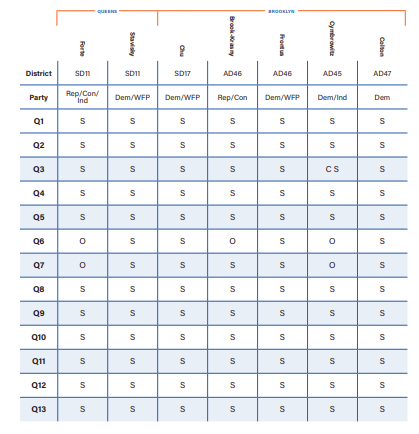
Citizens Union evaluates candidates for office to determine who strongly supports our issues, can advance a reform agenda, and can best fulfill the obligations of the position. Interview teams made up of 30 volunteer Local Candidates Committee members and Citizens Union Board members assessed the candidates based on their responses to Citizens Union’s questionnaire, research, first-hand knowledge of the candidates, and interviews with the candidates. The Citizens Union Board considers the recommendations of the Local Candidates Committee and makes a final decision.

You can find our candidate evaluation below. Click the tabs above to find more information on candidates’ responses to Citizens Union’s questionnaire and our positions on the ballot questions.


Read the full Voters Directory here: Citizens Union Voters Directory 2022 General


Press release: Citizens Union Announces Endorsement of Kathy Hochul for New York State Governor

Press release: Citizens Union Announces Endorsements of Three Candidates for State Senate and Assembly in Competitive General Election

Press release: Citizens Union Announces Positions on a Statewide Ballot Proposal and Three Citywide Ballot Proposals for 2022 General Election

Statewide

New York State Governor

Brooklyn

Assembly District 46
Senate District 17

Queens

Senate District 11
Proposal 1:
VOTE Yes

Proposal Number 1, an Amendment: Clean Water, Clean Air and Green Jobs Environmental Bond Act of 2022

To address and combat the impact of climate change and damage to the environment, the Act authorizes the sale of state bonds up to four billion two hundred million dollars to fund environmental protection, natural restoration, resiliency, and clean energy projects. Shall the Environmental Bond Act of 2022 be approved?

CITIZENS UNION SUPPORTS THIS PROPOSAL

The 2022 Environmental Bond Act—the largest Bond Act measure ever on the ballot in New York —would fund the state’s aggressive plans to mitigate and adapt to the growing impacts of climate change. If passed, the state would issue and sell up to $4.2 billion of general obligation bonds to provide long-term, dedicated funding for specified categories of environmental capital projects. These include restoration and flood risk reduction, water quality improvement and resilient infrastructure, open space land conservation and recreation, and climate change mitigation. At least 35% of the total $4.2 billion is required to be spent in “disadvantaged communities,” with a goal of reaching 40%.

In recent years, New York State has enacted several measures meant to drastically reduce greenhouse gas emissions and fully transition to clean energy, including the 2019 Climate Leadership and Community Protection Act, one of the most ambitious climate laws in the country. The U.S. Congress has approved massive funding and incentives for production of electric power, construction of renewable energy projects, and development of advanced technologies for clean energy. The Environmental Bond Act before the voters would provide the funding needed to achieve the goals set by those laws.

New York State’s history with environmental bond acts goes back to 1910, and previous bond acts have obligated roughly $30 billion (adjusted) towards environmental programs and projects. Citizens Union has supported such bond acts in the past, including the most recent one, The Clean Water/Clean Air Bond Act of 1996. Citizens Union also supported other bond acts to fund large scale transportation projects, including in 2005, 2000, and 1983.

The 2022 Environmental Bond Act offers a historic opportunity to provide essential funding for New York’s ambitious efforts in combatting the adverse impacts of climate change, as well as to further environmental justice and simultaneously stimulate the economy. It is consistent with past efforts by the state to lead and implement programs to further environmental protection, natural resource conservation, and the related quality of life in the state. Citizens Union considers the Environmental Bond Act a prime example of good government and recommends supporting it.

Proposal 2:
VOTE Yes

Proposal Number 2, a Question: Add a Statement of Values to Guide Government

This proposal would amend the New York City Charter to: Add a preamble, which would be an introductory statement of values and vision aspiring toward “a just and equitable city for all” New Yorkers; and Include in the preamble a statement that the City must strive to remedy “past and continuing harms and to reconstruct, revise, and reimagine our foundations, structures, institutions, and laws to promote justice and equity for all New Yorkers.” The preamble is intended to guide City government in fulfilling its duties. Shall this proposal be adopted?

CITIZENS UNION SUPPORTS THIS PROPOSAL

In March 2021, former Mayor de Blasio established a charter revision commission intended to focus on racial justice and reconciliation, with a two-year mandate to identify and root out structural racism, called The Racial Justice Commission. The Commission identified what it called “six patterns of inequity” that present systemic barriers to power, access, and opportunity for New Yorkers, and has put three proposals before the voters to address those issues. The goals of all three proposals are worthy objectives in line with the values of Citizens Union. Racial equity is a critical goal for New York City, and the charter proposals reflect the lived experience of many in a City that is majority people of color, with a long history of racial inequity. The proposals would place a focus on inequality that currently is lacking in the Charter or the City’s operational structure. Citizens Union does have concerns as to whether the proposals will lead to meaningful change. There is no assurance that the Racial Equity Plan will be implemented or that spending will be allocated based on it (although implementation is tied to the budget cycle). Citizens Union believes that for the proposals to be effective, City leaders must exercise strong, committed and ongoing leadership from the Mayor on down.

Proposal 2 would establish a Charter preamble focusing on equity for all New Yorkers, intended to guide policy-makers. The New York City Charter does not currently have a preamble. This amendment would add a preamble to the charter that declares an intention and vision to create a more equitable future. The ballot proposal would add Charter section 1151-a, which defines the effects of the preamble. It would require City agencies and officials to “to consider and be guided” by the values stated in the preamble, and to “examine” whether these values are being realized. However, it explicitly states the preamble does not create “direct or indirect right of action to enforce its terms.”

Proposal 3:
VOTE Yes

Proposal Number 3, a Question: Establish a Racial Equity Office, Plan, and Commission

This proposal would amend the City Charter to: Require citywide and agency-specific Racial Equity Plans every two years. The plans would include intended strategies and goals to improve racial equity and to reduce or eliminate racial disparities; Establish an Office of Racial Equity and appoint a Chief Equity Officer to advance racial equity and coordinate the City’s racial equity planning process. The Office would support City agencies in improving access to City services and programs for those people and communities who have been negatively affected by previous policies or actions, and collect and report data related to equity; and Establish a Commission on Racial Equity, appointed by City elected officials. In making appointments to this Commission, elected officials would be required to consider appointees who are representative of or have experience advocating for a diverse range of communities. The Commission would identify and propose priorities to inform the racial equity planning process and review agency and citywide Racial Equity Plans. Shall this proposal be adopted?

CITIZENS UNION SUPPORTS THIS PROPOSAL

In March 2021, former Mayor de Blasio established a charter revision commission intended to focus on racial justice and reconciliation, with a two-year mandate to identify and root out structural racism, called The Racial Justice Commission. The Commission identified what it called “six patterns of inequity” that present systemic barriers to power, access, and opportunity for New Yorkers, and has put three proposals before the voters to address those issues.The goals of all three proposals are worthy objectives in line with the values of Citizens Union. Racial equity is a critical goal for New York City, and the charter proposals reflect the lived experience of many in a City that is majority people of color, with a long history of racial inequity. The proposals would place a focus on inequality that currently is lacking in the Charter or the City’s operational structure. Citizens Union does have concerns as to whether the proposals will lead to meaningful change. There is no assurance that the Racial Equity Plan will be implemented or that spending will be allocated based on it (although implementation is tied to the budget cycle). Citizens Union believes that for the proposals to be effective, City leaders must exercise strong, committed and ongoing leadership from the Mayor on down.

Proposal 3 would require the city to establish a bi-annual racial equity plan, which would be managed by a new office and overseen by a new commission. The racial equity plan would outline short term and long-term racial equity goals and strategies, performance and outcome indicators, and guidance for agencies. The planning process for the racial equity plan would sync up with the citywide budget process to align NYC’s spending priorities with equity priorities. There is no requirement for spending to be allocated. Covered agencies would be required to complete individual agency racial equity plans, which would be incorporated into the mayor’s citywide racial equity plan. A new Office of Racial Equity, led by a mayoral appointee, would be tasked with developing the plan and supporting city agencies in the process. The Office would also establish an access design program to reduce barriers to City services. Finally, the proposed amendment would also create a commission on racial equity, which would act as an oversight body on the racial equity plan and enable community members with equity expertise and lived experience to influence city decision-making.

Proposal 4:
VOTE Yes

Proposal Number 4, a Question: Measure the True Cost of Living

This proposal would amend the City Charter to: Require the City to create a “true cost of living” measure to track the actual cost in New York City of meeting essential needs, including housing, food, childcare, transportation, and other necessary costs, and without considering public, private, or informal assistance, in order to inform programmatic and policy decisions; and Require the City government to report annually on the “true cost of living” measure. Shall this proposal be adopted?

CITIZENS UNION SUPPORTS THIS PROPOSAL

In March 2021, former Mayor de Blasio established a charter revision commission intended to focus on racial justice and reconciliation, with a two-year mandate to identify and root out structural racism, called The Racial Justice Commission. The Commission identified what it called “six patterns of inequity” that present systemic barriers to power, access, and opportunity for New Yorkers, and has put three proposals before the voters to address those issues. The goals of all three proposals are worthy objectives in line with the values of Citizens Union. Racial equity is a critical goal for New York City, and the charter proposals reflect the lived experience of many in a City that is majority people of color, with a long history of racial inequity. The proposals would place a focus on inequality that currently is lacking in the Charter or the City’s operational structure. Citizens Union does have concerns as to whether the proposals will lead to meaningful change. There is no assurance that the Racial Equity Plan will be implemented or that spending will be allocated based on it (although implementation is tied to the budget cycle). Citizens Union believes that for the proposals to be effective, City leaders must exercise strong, committed and ongoing leadership from the Mayor on down.

Proposal 4 would require city government to develop and report, beginning in 2024, an annual “true cost of living” measurement of what it costs to live in New York City without consideration of public, private, or informal assistance. The new measure is meant to complement existing measures such as the federal poverty line, which is often seen as an outdated and inaccurate standard, or the NYCgov poverty measure, which misses many poor households because it calculates public assistance as income, putting many families above the poverty line.