




Recommendations to the New York City Commission on Government Efficiency
This written testimony summarizes Citizens Union’s recommendations to the 2026 Charter Revision Commission, also known as the Commission on Government Efficiency (COGE).
Citizens Union is a nonpartisan good government group fighting for honest and accountable government, free and open elections, and reforming New York City and State governments. Throughout our nearly 130 years, we have played a role in nearly every charter revision process. We have advised commissions, had members serve as commissioners, and helped place reforms on the ballot and secure their passage.
This written testimony is divided into four parts: ethics and accountability, government modernization, democracy and elections, and charter revision process reform.
Ethics and Accountability: Preventing Waste, Fraud, and Misuse of Resources
Establish Minimum Budgets for the Department of Investigation and the Conflicts of Interest Board
Reducing red tape, streamlining permitting, and increasing government capacity to execute its mission are all crucial to providing New Yorkers with effective services. But as this commission tackles longstanding bureaucratic hurdles, it should also prioritize strengthening public integrity and accountability by ensuring we have strong, independent oversight agencies that keep government effective, efficient, and committed to the public interest.
Strong watchdogs save taxpayer dollars by investigating ethics violations, combating corruption and abuses of power, and protecting taxpayer money from fraud and waste.
The Department of Investigation generated more than $6 million in financial recoveries last year.[1] The Conflicts of Interest Board provides same-day legal advice to thousands of city employees annually, helping prevent violations before they occur.[2]
To fulfill their mandates, these agencies must have the independence and resources to operate without undue influence from the branches of government they oversee.
That is why earlier charter revision commissions established budget protections for other essential independent agencies, including the Campaign Finance Board, the Independent Budget Office, and the Civilian Complaint Review Board.
But two of the city’s most important oversight agencies, the Department of Investigation (DOI) and the Conflicts of Interest Board (COIB), do not enjoy such budget protections. As a result, they suffer from chronic underfunding that impairs their missions.
The Department of Investigation has lost over 100 staff in recent years—a period that coincided with the agency’s high-profile investigations into former Mayor Eric Adams. [3]
These staffing losses have measurable consequences. According to the Mayor’s Management Report[4], the average time to complete DOI investigations has increased from 201 days in FY2023 to 251 days in FY2025. And it’s on track to get even worse, with data from the first four months of FY2026 showing that it is now taking an average of 325 days to complete an investigation. Background checks and the vetting of new public sector hires are also taking longer. As staffing declines and caseloads grow, the City’s ability to detect and address misconduct in a timely manner is increasingly at risk. At a recent Council hearing, DOI Commissioner Nadia Shihata warned that the proposed executive budget would have a tangible impact on the agency’s ability to fulfill its anti-corruption mandate.[5]
The Conflicts of Interest Board has nearly the same headcount it had when it was founded in 1990, despite enormous growth in the size of the city workforce, the city’s budget, and COIB’s own responsibilities—which now include oversight of legal defense trusts and affiliated not-for-profits.[6] The widening gap between a sprawling municipal government and the small agency tasked with enforcing its ethics laws poses a serious risk to the city’s ability to maintain clean, honest government.
Even when these agencies receive budget allocations for new personnel, that funding may be withheld or modified under the Mayor’s impoundment authority during the year. Both COIB and DOI have testified about the Office of Management and Budget’s refusal to approve funding for vacancies.
To ensure these watchdogs’ independence, protect them against politically motivated cuts, and preserve the city’s internal waste-reduction mechanisms, the DOI and COIB should be guaranteed minimum budgets.
This Commission can build directly on work already done. The Commission to Strengthen Local Democracy—the charter commission established by the City Council—recognized the need to strengthen both agencies and developed charter amendments, already vetted by the Law Department, that would set minimum funding levels of 0.06 percent and 0.0035 percent of the city’s total budget for DOI and COIB, respectively.[7] Given this Commission’s tight timeline, those proposals are well positioned for adoption.
This reform is long overdue. A wide range of stakeholders—advocates, prior Public Advocates, Council Members, and agency commissioners themselves—have repeatedly called for a minimum budgets for COIB and the DOI through proposals to previous charter revision commissions and legislation introduced in the Council.[8]
Merge Lobbying with Ethics Oversight – from the City Clerk to the Conflicts of Interest Board
Restructuring oversight bodies is another way to preserve taxpayer dollars and improve government effectiveness and accountability. Chief among the needed reforms is lobbying oversight.
New York City’s lobbying industry grows every year, with $144.5 million spent in 2025 alone.[9] Effective lobbying oversight is essential to ensuring that public resources serve the public interest rather than private interests. Yet the regulation of the lobbying industry is better suited to a small town that focuses on administrative recordkeeping than to the largest municipal lobbying market in the country.
Lobbying oversight is currently handled by the City Clerk, an office appointed by and housed within the City Council—the very body in which most lobbying takes place. This arrangement creates an inherent conflict of interest.
The City Clerk’s Lobbying Bureau, a five-person unit, focuses primarily on compliance rather than enforcement. Its enforcement tools are limited: it administers late fees, conducts approximately 45 audits per year, and has issued just $10,000 in civil penalties since 2018. Few violations, if any, are referred to DOI.[10]
Effective lobbying regulation in other major cities is conducted by joint lobbying-ethics agencies. Several of the nation’s largest cities use this model, including Los Angeles (City Ethics Commission), Chicago (Board of Ethics), Philadelphia (Board of Ethics), San Francisco (Ethics Commission), and San Antonio (Ethics Review Board). New York State similarly consolidates these functions in the Commission on Ethics and Lobbying in Government (COELIG).
We recommend transferring lobbying oversight to COIB, with dedicated funding and staffing for this expanded responsibility.
COIB already oversees lobbyists under the Lobbying Gifts Law and manages disclosure reporting for over 10,000 individuals. Given its expertise in ethics regulation, consolidating lobbying oversight under COIB would create a more coherent and effective system.
Consolidate the Three External Police Oversight Bodies into One Board
A significant challenge for police accountability in New York City is the fragmentation system of oversight.
Former Judge James Yates, who, by order of a federal court judge in the NYPD stop-and-frisk cases conducted the most comprehensive analysis of the NYPD discipline system, found a dozen offices and agencies—both inside and outside the NYPD—that oversee police actions. Yet coordination among them is limited and access to NYPD information is inconsistent, undermining their collective effectiveness.[11]
A more effective system should be utilized.
The three primary external oversight bodies—the Inspector General for the NYPD (OIG-NYPD), the Mayor’s Commission to Combat Police Corruption (CCPC), and the Civilian Complaint Review Board (CCRB)—should be consolidated into a single Police Oversight Board. Consolidation would strengthen collective capacity and streamline access to NYPD information.
The OIG-NYPD and the CCPC perform similar and somewhat overlapping functions. The CCRB serves a somewhat different purpose, but its ability to investigate complaints, obtain relevant information, and prosecute wrongdoing could be strengthened as part of a larger and more comprehensive police oversight agency.
The consolidation proposal was included in the 2021 NYC Police Reform and Reinvention Collaborative Plan[12] and endorsed by then-Mayor Bill de Blasio. DOI had recommended the same approach in its December 2020 report on the NYPD’s response to George Floyd protests[13]. The proposal was not included in the 2021 City Council resolution implementing the reform plan. Given ongoing concerns about police accountability, it should be revisited.
Modernizing Government: How the City Manages Its Workforce and Its Technology
We urge the Commission to be bold in addressing two areas where structural reform is overdue: civil service and technology.
Explore Civil Service and Municipal Workforce Reform
Citizens Union has helped shape the city’s workforce since our founding nearly 130 years ago. We championed the transition from Tammany Hall patronage to merit-based civil service and were part of the effort that established the city’s first civil service system.
And across many decades since, we’ve documented where that system has fallen short.[14]
Today, more than 13,000 positions sit vacant. Hiring a single civil servant often takes over a year, sometimes even longer, largely due to the current exam system and the required hiring processes for qualified candidates. This is not sustainable for a modern city. If we cannot staff the agencies within city government responsible for essential services, such as building housing or maintaining our parks, then our city will fall behind.
The rules set to safeguard civil service hiring and workforce management have been the subject of criticism for decades, and some issue experts argue that New York City’s civil service system ranks worst in the country.[15]
While civil service is largely a state matter, the city retains meaningful room to modernize within existing constraints. We encourage the Commission to make this a priority in its final report. Some ideas already raised by advocates—including meaningful performance evaluations, broadbanding titles to ease the exam burden on DCAS, and moving toward continuous rolling recruitment—are especially worth exploring.[16]
Address the Use of Tech in Government
Technology faces similar problems. City government’s use of technology is hampered by procurement delays, vendor capture, and data fragmentation. The procurement process is so lengthy that by the time an agency’s new product—whether a website, a portal, or something else—is actually deployed, the technology is already outdated.
Additionally, because the city contracts out its applications to external vendors, the vendor assigned to build the initial application is often the only one who can fix it. This allows the vendor to dramatically upcharge what it really costs to fix the issue, wasting what some have argued is hundreds of millions of dollars on single applications alone.[17]
When different vendors build different applications, the resulting data is siloed and cannot easily be shared or integrated across agencies. Creating systems that enable interoperability, with appropriate data management and segmentation, would significantly increase efficiency.
Experts broadly agree that the answer is to build more capacity in-house, [18] meaning that the city would hire the workers who build technology applications directly, not through contractors. This would allow the city to bypass convoluted procurement processes, deliver up-to-date products, avoid vendor capture, and enable data interoperability, potentially saving the city hundreds of millions, if not eventually billions of dollars.[19] This may require civil service reform and therefore, state action.
In the meantime, a dedicated NYC digital service team working on a project-by-project basis is worth serious exploration.[20] A 200-person team at the United States Digital Service saved the federal government $3.5 billion in 2019 alone—a 17-to-1 return on investment.[21] A few dozen people working in exempt roles outside exam requirements could generate real savings for New York City while broader reform takes shape.
Democracy and Elections: Open Primaries and Independent Expenditure Reform
Opening New York City’s Closed Partisan Primary System
New York City is one of the few large cities that still uses a closed partisan primary. Because the winner of the Democratic primary—and in some areas, the Republican primary—is effectively guaranteed to win the general election, and because primary turnout is low, a very small share of the voting-age population ultimately decides who holds office.[22]
The partisan primary system is particularly exclusive of the more than 1 million “independent” or “unaffiliated” voters, who are not enrolled in any political party and are locked out of any primary. The rate of unaffiliated voters has been steadily increasing and now accounts for nearly 22% of registered voters in New York City, over twice the number of Republican voters. Younger generations tend more to identify as independent, and research has shown that unaffiliated voters are engaged in politics and believe voting is their civic duty.
New York City should open its primary system to all voters, while retaining party designations on the ballot so voters have relevant context about candidates. We have presented such recommendations to previous charter commissions as well.
Reforming the Independent Expenditure Disclosure Regime
New York City’s first rules regulating super PACs—also known as independent expenditure committees—were adopted by voters based on the recommendations of the 2010 Charter Revision Commission, immediately following the U.S. Supreme Court’s Citizens United decision opened the door to unlimited, unregulated spending in American elections.
The most recent municipal election demonstrated that the regulatory framework governing independent expenditures (IEs) requires significant improvements. More than any other development in the 2025 election cycle, IE activity reached new levels of scale, complexity, and intensity, and poses the greatest long-term risk to the City’s campaign finance system.
A key development was the use of intermediary pass-through entities—including political committees and LLCs—to channel millions of dollars into IE spending, significantly undermining the City’s dark money disclosure regime. Independent spenders have also exploited administrative grace periods, delayed enforcement, trivial penalties, and divergent state and city rules to minimize disclosure before Election Day.
These practices are already prevalent in state and federal elections, and the risk of their expansion in New York City is real. Creating a donor-nesting scheme is neither legally nor administratively complex, and the costs are easily absorbed by large spenders. If widely adopted, such methods would significantly erode a disclosure framework that has historically been one of New York City’s most important campaign finance safeguards.
Citizens Union has proposed several reforms to the disclosure rules, including enacting new donor traceback requirements modeled on Arizona’s 2022 Voters’ Right to Know Act, strengthening enforcement and compliance mechanisms, and increasing penalty limits for violations.
More information is available in our most recent testimony to the Campaign Finance Board[23]
Charter Revision Commission Process: Vulnerabilities and Reform
Finally, Citizens Union believes the charter revision process itself merits reexamination.
It is a topic this panel knows well, given the commissioners’ extensive government service and involvement with prior charter revision commissions.
Revising the City Charter through popular referendum is a critical component of New York City’s system of government. Charter revision commissions have produced some of the city’s most important reforms, helping create a more effective, accountable, and responsive government.
Charter revision commissions are also an innovative governing tool we wish other levels of government would possess. They combine the strengths of an independent expert panel—with the capacity to examine fundamental questions of governance in relative isolation from daily political pressures —with the legitimacy of direct democracy through a public vote.
But recent experience suggests that the charter revision process is drifting away from the qualities that make it valuable. Charter revision should be an extraordinary tool for structural reform, conducted through a deliberative and open process. Vulnerabilities in the current system, resurfaced repeatedly in recent years, have allowed for misuse of the city’s governing document for political maneuvering, little public input, and growing cynicism.
We urge the Commission to examine not only what reforms belong in the Charter, but also how the charter revision process itself can better reflect those principles.
Restore the Charter Revision Process as an Extraordinary Tool Reserved for Major Structural Reforms
The 1989 Charter Revision Commission is often brought up as a role model for such panels. But the truth is charter commissions are no longer being used as extraordinary bodies convened to address fundamental questions of governance. Eight commissions have been established in the last eight years—more than were created during the nearly 30 years before that. By comparison, there were only five commissions in the half-century between the 1938 Charter and the adoption of the 1989 Charter.
This rapid growth is turning charter revision into a routine mechanism for bypassing the normal legislative process, despite the existence of an elected legislative body.
Chart 1: The Growth of Charter Revision Commissions in New York City, 1938 to 2026
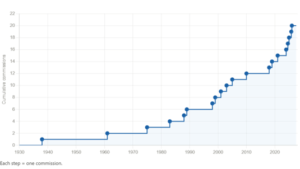
That trend is reinforced by the fact that many proposals submitted to voters resemble ordinary legislation that could be enacted by local law or even addressed administratively without requiring a referendum.
The city should consider ways to preserve charter revision as an extraordinary process, including establishing limits on the frequency of commissions or reexamining the types of proposals that warrant a referendum.
Protect the Charter Revision Process from Political Manipulation
The City Charter is New York City’s foundational governing document. Decisions about when and how it is revised should be driven by the public interest and the merits of proposed reforms, not by short-term political gamesmanship.
Yet many recent commissions have been created primarily for strategic political reasons. Most charter commissions established during the last three years were created by mayors to “bump,” or block, other ballot questions. We have repeatedly criticized this undemocratic power.[24] Although the State Legislature attempted to eliminate it last year, that legislation was unfortunately vetoed by Governor Kathy Hochul.[25]
The State recently addressed one vulnerability by closing the loophole allowing mayors to appoint “lame-duck” commissions, after Mayor Eric Adams established a charter revision commission on his final day in office, but further refinements are still needed.[26]
Political incentives also contribute to commissions being established far too late in the year. Both the 2024 Charter Commission and this Commission effectively operated on roughly two-month timelines during the summer and election season – among the shortest charter revision processes in the city’s history. When commissions are established at the last minute, they have little opportunity to gather public input, conduct research, or engage in a thorough and deliberative process.
We greatly appreciate this Commission’s efforts to engage the public and have been impressed by commissioners thoughtful considerations of issues at hearings. Nevertheless, we believe short-term charter commissions should not be permitted. Our proposal for minimum timeframes is detailed below.
Chart 2: Duration of New York City Charter Revision Commissions, First to Last Meeting
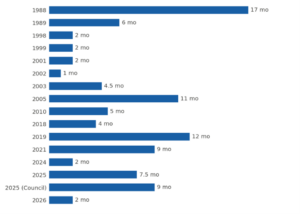
Additional safeguards are needed to protect the charter revision commissions from further politization. The City should reconsider the appointment powers so that more elected officials and branches of government are represented on commissions, and commissions’ sole discretion on drafting ballot questions.
Establish Rules for a Deliberative and Open Charter Revision Process
Meaningful public participation and adequate deliberation are essential for successful charter commissions. Yet only very rudimentary transparency and public input practices are codified in Minimum procedural requirements should be established. That includes:
- Minimum timeframes
For charter revision commissions, we recommend requiring at least 180 days between a commission’s first meeting and the filing of ballot proposals with the City Clerk, as well as at least 30 days between publication of a commission’s final report and the filing of ballot proposals. Currently, commissions are only required to hold a single public hearing and could theoretically be established just days before the ballot-filing deadline. We made a similar recommendation to the 2024 and 2025 charter revision commissions, and legislation has been previously introduced in Albany to implement such timetables[27]Similarly, the City Council should not be able to place Charter amendments before voters without sufficient time for public engagement. We recommend requiring that any local law proposing a Charter amendment that must be approved by referendum be passed twice by the Council, with at least 30 days between votes, and that a public hearing be held before each vote. This mirrors the amendment process for the New York State Constitution, which requires constitutional amendments to pass twice before appearing on the ballot.
- Robust public hearing and transparency requirements: Although commissions often hold hearings in every borough, they are not required to do so and may conduct their work with limited transparency.The commission established by former Mayor Adams on December 31 is currently operating without a website, without webcasts of its meetings, and without making public its reports or resolutions public. Some commissions have regularly published testimony received from the public; others have never done so.
Clear rules should ensure that commissions meaningfully solicit and incorporate input from stakeholders, experts, and the public.
Although the charter revision process is governed by the Municipal Home Rule Law, New York City retains authority to establish its own procedural rules on charter revision so long as they do not conflict with state law. That is the case for most of issues mentioned above.
In fact, a Charter Revision Commission currently operating in Buffalo has advanced preliminary recommendations to codify charter revision procedures in the Buffalo City Charter, addressing weaknesses in its own system, like periodical commissions, a fixed appointment structure, and eligibility requirements for commissioners.[28] Citizens Union is not advocating for these specific reforms, but Buffalo’s example demonstrates that cities can take the initiative to strengthen and modernize their charter revision processes.
The issue is not whether charter revision commissions remain valuable. They do.
Given the recent problems surrounding charter revision and the growing interest in reform at both the city and state levels, there is a window of opportunity to strengthen this important mechanism for structural reform further erosion of public confidence occurs. We urge the Commission to address these issues in its final report.
[1] The New York City Department of Investigation – 2025 Annual Report https://www.nyc.gov/assets/doi/press-releases/2026/February/04CYend2025.02.18.2026.Visual.Release.pdf
[2] The New York City Conflicts of Interest Board – 2025 Annual Report https://www.nyc.gov/assets/coib/downloads/pdf2/annual_reports/2025-nyc-coib-annual-report.pdf
[3] March 18, 2026 Testimony of Christopher Ryan, Acting Commissioner, NYC Department of Investigation before the Council Committee on Oversight and Investigations https://www.nyc.gov/assets/doi/Testimony/2026/DOIPrelimBudgetTestimony.CYend.03.18.2026FINAL.pdf
[4] The Mayor’s Management Report (MMR) – Department of Investigation https://dmmr.nyc.gov/city-services/public-safety-and-access-to-justice/department-of-investigation
[5] June 2, 2026 Testimony of Commissioner Nadia I. Shihata on DOI’s FY 2027 Executive Plan, before the Council Committee on Oversight and Investigations https://www.nyc.gov/assets/doi/Testimony/2026/DOITestimonyExecBudget.06.02.2026Final.pdf
[6] Testimony before the New York City Council Committee on Finance and the Committee on Governmental Operations,
State & Federal Legislation Concerning the FY27 Executive Budget, Carolyn Lisa Miller, Executive Director, NYC Conflicts of Interest Board https://legistar.council.nyc.gov/View.ashx?M=F&ID=15559237&GUID=F2A3E2A3-7FBB-41BB-99A9-B5F110D5687F
[7] The NYC Commission to Strengthen Local Democracy Final Report https://static1.squarespace.com/static/678ab684e1a2cb193dfc38af/t/6930a3eb72d92366241d0693/1764795371419/FINAL_Report_12.3.25_w_appendices.pdf
[8] Conflicts of Interest Board, “Past and Proposed Charter Amendments,” available at https://www.nyc.gov/site/coib/the-law/past-charter-revisions-and-proposed-amendments.page ; Testimony of DOI Commissioner Jocelyn E. Strauber to Commission to Strengthen Local Democracy https://static1.squarespace.com/static/678ab684e1a2cb193dfc38af/t/6839c408899dec43c683a71a/1748616200735/Department+of+Investigations+Testimony.pdf; June 2, 2026 Testimony of Commissioner Nadia I. Shihata on DOI’s FY 2027 Executive Plan, before the City Council https://www.nyc.gov/assets/doi/Testimony/2026/DOITestimonyExecBudget.06.02.2026Final.pdf; Citizens Union, 2010. City Charter Revision Recommendations: Increasing Avenues for Participation in Governing and Elections in New York City. https://citizensunion.org/wp-content/uploads/2010/06/0610CU_Charter_Revision_ReportRecommendations.pdf; legislation Int. No. 1099-2009; Int. No. 0095-2010; Int. No. 1045-2009; Final reports of the following charter revision commissions: 2002 Charter Revision Commission, at 113–116, https://www.nyc.gov/assets/charter/downloads/pdf/2002_final_report.pdf, 2003 Charter Revision Commission, at 136, 156–157, https://www.nyc.gov/assets/charter/downloads/pdf/final_report2003.pdf, 2018 Charter Revision Commission, at 122–123, 127, https://www.nyc.gov/assets/charter/downloads/pdf/final-report-20180904.pdf.
[9] Clerk of the Council, Lobbying Bureau, March 2026 Annual Report https://www.cityclerk.nyc.gov/assets/cityclerk/downloads/pdf/2026%20Annual%20Report%20final.pdf
[10] Office of the New York City Clerk, Lobbying Bureau Annual Reports; Testimony by the New York City Clerk before the Committee on Governmental Operations, State & Federal Legislation. April 19, 2024.
[11] James Yates, September 19, 2024. Report to the Court on Police Misconduct and Discipline. https://www.nypdmonitor.org/wp-content/uploads/2024/09/Discipline-Report.pdf
[12] The New York City Police Reform and Reinvention Collaborative Plan, found at: https://www.nyc.gov/site/policereform/reform-plan/reform-plan.page
[13] New York City Department of Investigations, December 2020. Investigation into NYPD Response to George Floyd Protests. https://www.nyc.gov/assets/doi/reports/pdf/2020/DOIRpt.NYPD%20Reponse.%20GeorgeFloyd%20Protests.12.18.2020.pdf
[14] See for example, 1976 Citizens Union report: Beaumont, Enid F. Promoting Efficiency in Government: Proposals for a New Personnel System for the City of New York. 2012 Citizens Union report: Tensions, Trends and Trade-Offs: Recommendations Towards an Equitable, Efficient, and Effective New York City Civil Service System. https://citizensunion.org/wp-content/uploads/2016/07/CU_CapstoneReport_CivilServiceReform.pdf. 5BORO Institute 2023 report: Solving the Staffing Crisis: Saving City Government for New Yorkers. https://fiveboro.nyc/wp-content/uploads/2023/02/Solving-the-Staffing-Crisis.pdf.
[15] Robert Gordon and Gabe Paley, “New York’s Civil Service System vs. Public Sector Progress,” Vital City, November 11, 2025, https://www.vitalcitynyc.org/new-yorks-mamdani-ny-civil-service-system/.
[16] Robert Gordon, “The Wrong Kind of Outlier,” June 16, 2026, https://robertmgordon.substack.com/p/the-wrong-kind-of-outlier; Lewis, Caitlin. “NYC Has the Power to Fix Its Hiring Process—The Charter Commission Should Use It.” Searchlight, June 23, 2026. https://searchlight.citizensunion.org/nyc-has-the-power-to-fix-its-hiring-process-the-charter-commission-should-use-it/.
[17] Hendrick Townley, “Vendor Capture in NYC Government,” Tech Mayor NYC, December 9, 2025, https://techmayor.nyc/p/vendor-capture-in-nyc-government.
[18] Jordan Shapiro, “Testimony to the Commission on Government Efficiency, COGE, a Charter Revision Commission,” BetaNYC, June 11, 2026, https://www.beta.nyc/2026/06/11/coge-testimony/
[19] Bannon, Leah. “COGE Testimony.” June 11, 2026. https://docs.google.com/document/d/1rnT9IfxA97nYf8k3cLVe7q58-r4kuArlXGc2uKvEWAU/edit?tab=t.0.
[20] Rebecca Heywood, “What I Said to New York City’s Commission on Government Efficiency,” #PublicSectorJobBoard, June 16, 2026, https://publicsectorjobboard.substack.com/p/what-i-said-to-new-york-citys-commission.
[21] Tech Mayor NYC, “NYC’s Digital Service Teams,” Tech Mayor, January 1, 2026, https://drive.google.com/file/d/1Ov6yHYxdGN3VLc9Fy98qEdRnd_HWBJzn/view.
[22] See more at Charter Reforms for Better New York City Government – Citizens Union report for the 2025 Charter Revision Commissions https://citizensunion.org/wp-content/uploads/2025/02/Charter-Reforms-for-Better-New-York-City-Government-Citizens-Union-Report-Feb-2025.pdf
[23] The New York City Campaign Finance Board 2025 Post Election Hearing – Supplemental Testimony from Citizens Union https://citizensunion.org/wp-content/uploads/2026/06/CFB-2025-Post-Election-Hearing-Supplemental-Testimony-from-Citizens-Union.pdf
[24] Mayor Adams’ Proposed Final-Day Charter Commission Lacks Mandate, Credibility, and Makes Mockery of City’s Charter Revision Process (Dec. 31, 2025), https://citizensunion.org/document/2025-12-31/mayor-adams-proposed-final-day-charter-commission-lacks-mandate-credibility-and-makes-mockery-of-citys-charter-revision-process/. Statement from Citizens Union on Mayor Adams’ Announcement of a New Charter Revision Commission (Dec. 13, 2024), https://citizensunion.org/document/2024-12-13/statement-from-citizens-union-on-mayor-adams-announcement-of-a-new-charter-revision-commission/; Testimony Before the 2024 Charter Revision Commission: Government and Election Reform Hearing (June 17, 2024), https://citizensunion.org/document/2024-06-17/testimony-before-the-2024-charter-revision-commission-government-and-election-reform-hearing/.
[25] Gov. Hochul’s Veto of Mayoral Referendum Bumping Bill: A Missed Opportunity to Stop Ballot Gamesmanship (Dec. 6, 2025), https://citizensunion.org/document/2025-12-06/gov-hochuls-veto-of-mayoral-referendum-bumping-bill-a-missed-opportunity-to-stop-ballot-gamesmanship/
[26] Bernadette Hogan & Kelly Mena, Sources: Legislature May Let Mamdani Disband Adams’ ‘Zombie’ Charter Commission, NY1 (May 20, 2026), https://ny1.com/nyc/all-boroughs/news/2026/05/20/eric-adams-charter-commission-moves-forward-without-mamdani-s-support. See also: Citizens Union Explainer: Charter Revision Commissions Appointed by Prior Mayors (Feb. 24, 2026), https://citizensunion.org/document/2026-02-24/explainer-charter-revisions-commissions-appointed-by-prior-mayors/.
[27] Citizens Union, Charter Reforms for Better New York City Government (Feb. 2025), https://citizensunion.org/wp-content/uploads/2025/02/Charter-Reforms-for-Better-New-York-City-Government-Citizens-Union-Report-Feb-2025.pdf. Citizens Union, Testimony Before the 2024 Charter Revision Commission: Government and Election Reform Hearing (June 17, 2024), https://citizensunion.org/document/2024-06-17/testimony-before-the-2024-charter-revision-commission-government-and-election-reform-hearing/; S590 (Krueger)/A3665 (Simone) – original version https://www.nysenate.gov/legislation/bills/2025/S590/.
[28] J. Dale Shoemaker, Buffalo Commission Will Draft Up Major Reforms to City Charter, Investigative Post (June 10, 2026), https://investigativepost.org/2026/06/10/buffalo-commission-to-draft-up-major-reforms-for-city/